

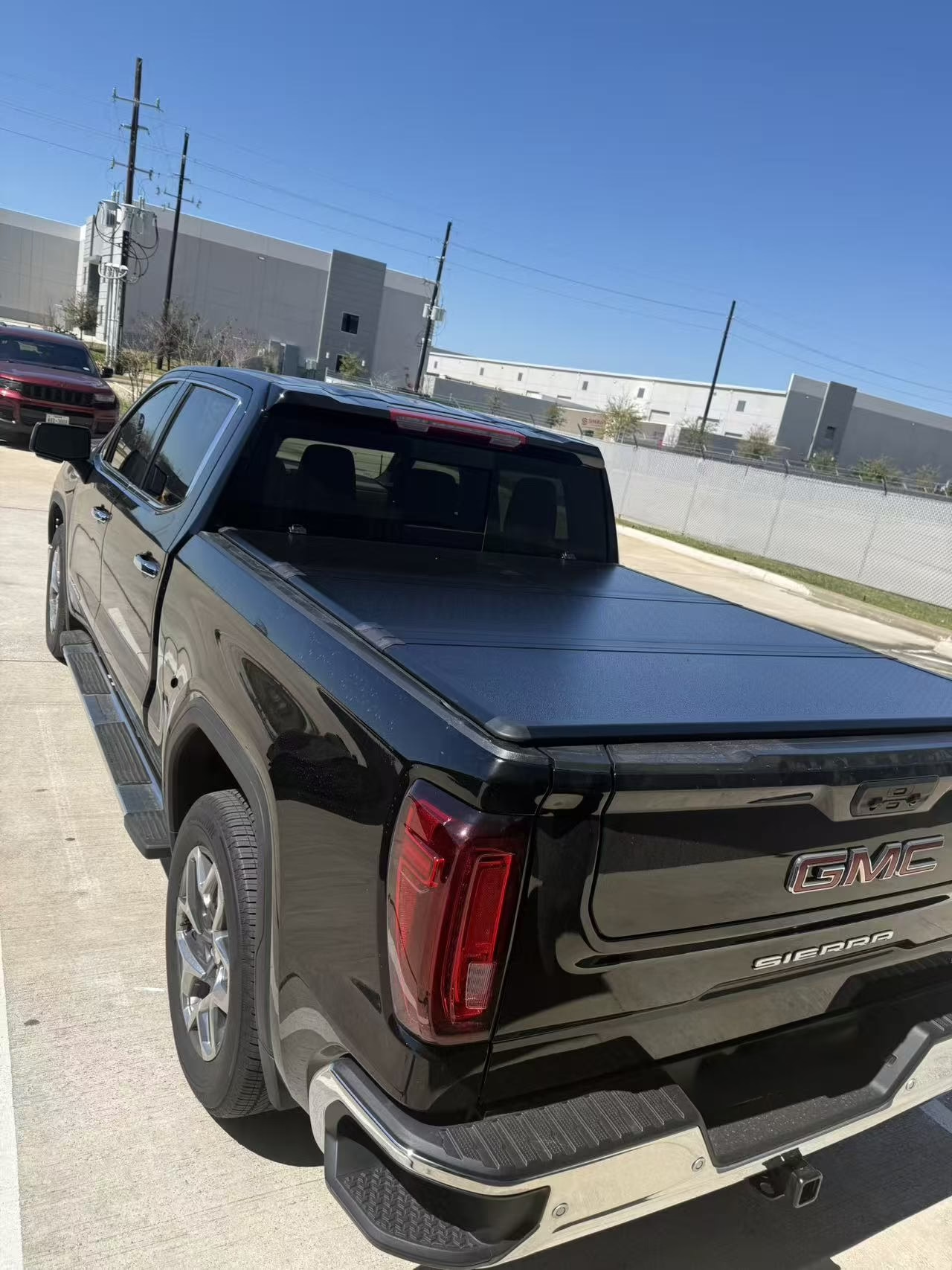
A tonneau cover for a work truck should suit the way you load, carry, and unload equipment throughout the day. Keeping tools out of sight is useful, but the cover also needs to work with your storage layout, your accessories, and the largest loads you regularly carry.
Before choosing a cover, think through a typical workday. Which items do you reach for at every stop? How often do you need the entire bed open? Do you carry equipment above the bed rails? These questions help you assess whether a hard tri-fold cover fits your routine.
Table of Contents
- Start With Daily Access to Your Equipment
- Check Cargo Height and Usable Bed Space
- Set Realistic Security Expectations
- Plan for Rain, Dust, and Dirty Equipment
- Confirm Toolbox and Rack Compatibility
- Consider Handling and Maintenance
- Prepare for an Installation Quote
- Frequently Asked Questions
Start With Daily Access to Your Equipment
A cover that works well for occasional hauling may feel inconvenient when you open the bed repeatedly between jobs. Consider where your most-used tools sit and how much of the cover you would need to open to reach them.
For example, a service technician carrying smaller cases may need convenient access near the tailgate. A contractor loading bulky equipment may need a much larger opening. The same cover can suit these routines differently.
When evaluating a hard tri-fold cover, check:
- How the rear panel releases and closes.
- How much space remains covered when the panels are folded.
- Whether full bed access requires removing the cover.
- Whether the folded panels affect access to storage near the cab.
- How the cover must be secured in its approved travel positions.
Opening arrangements vary by model. Ask to see the exact cover operate rather than assuming all hard tri-fold designs provide the same access.
Check Cargo Height and Usable Bed Space
Measure the equipment you normally carry, including stacked cases and storage bins. Compare those measurements with the usable clearance beneath the proposed cover, including any rails or components that extend into the bed.
If your loads change from day to day, plan for both the routine load and the occasional larger one. A setup that closes comfortably over tool cases may need a different arrangement for a compressor, landscaping equipment, or bulky materials.
Do not force the panels closed over cargo or let equipment press against the underside of the cover. Confirm how oversized loads would be carried and whether the cover would need to be removed.
Use only the manufacturer-approved opening positions and restraints when driving. Secure the cargo separately with appropriate tie-downs; a tonneau cover does not replace a cargo-restraint system.
Set Realistic Security Expectations
A closed hard cover keeps equipment out of sight and adds a rigid barrier over the bed. However, it does not make tools theft-proof or turn the truck bed into a secure overnight storage facility.
Ask how the selected model locks. Some designs rely on a locked tailgate to restrict access to the release mechanism, while others have a separate locking arrangement.
Consider your parking routine as well as the cover. Leaving equipment unattended at a job site or overnight involves different risks from transporting it between supervised stops. Follow your employer’s equipment-storage procedures and check any relevant insurance requirements.
Our guide to hard tri-fold tonneau cover benefits and trade-offs explains the broader advantages and limitations of this cover type.
Plan for Rain, Dust, and Dirty Equipment
A tonneau cover can help shield the bed from rain and road spray, but moisture-sensitive equipment still needs suitable storage. Do not assume a closed cover creates a completely waterproof or dust-free space.
Use appropriate protective cases for items such as meters, electronics, paperwork, and battery-powered equipment. Also consider what you put into the bed: wet hoses, muddy tools, or damp materials can introduce moisture even when the cover is closed.
Keep the cover’s sealing surfaces clear and inspect them according to the manufacturer’s instructions. If water enters unexpectedly, identify the source before applying sealants or changing hardware.
Confirm Toolbox and Rack Compatibility
A toolbox, ladder rack, or cargo-management system may share mounting space with a tonneau cover. Compatibility needs to be confirmed for the exact truck, cover, and accessory combination.
For a toolbox, check both its mounting location and the clearance needed to open the lid. For a rack, check the approved mounting system and whether its supports interfere with the cover’s panels or operating hardware.
Do not assume that a universal rack or an adapter will work with every cover. Ask for the relevant compatibility information before purchasing parts or modifying the truck.
Bed liners also deserve attention. Our guide to tonneau cover compatibility with a drop-in bed liner explains which areas to check around the rails and mounting points.
Consider Handling and Maintenance
Think about who will operate the cover and how often it may need removal. Panel weight, release locations, and the removal procedure matter when the truck is part of a busy work routine.
If several people use the truck, make sure each driver knows how to close the latches and secure the cover in its permitted positions. Keep the operating instructions available to the team.
Follow the manufacturer’s maintenance schedule and cleaning guidance. Pay attention to dirt around latches, worn seals, and changes in how the panels close. Do not use the cover as a workbench, standing platform, or storage shelf unless the manufacturer explicitly permits that use.
Prepare for an Installation Quote
When requesting a quote, describe how the truck is used as well as its vehicle details. A few measurements and photos can help identify questions that need answering before you select a cover.
- Truck year, make, model, and bed length.
- Photos of the bed rails, liner, toolbox, and rack, if fitted.
- The dimensions of equipment you need to carry under the closed cover.
- How often you need completely unobstructed bed access.
- Any existing cover or mounting hardware that needs assessment.
Ask what the quote includes and whether any additional parts or preparation would be needed. If you are weighing installation options, read our professional tonneau cover installation vs. DIY guide.
For hard tri-fold cover options and professional installation in Katy, Texas, contact Prime Truck Covers. Share your truck details and work setup to ask about compatible options, availability, and an installation quote.
Frequently Asked Questions
Is a hard tri-fold tonneau cover suitable for a work truck?
It can be, particularly when your usual equipment fits beneath the closed cover and the opening arrangement suits your loading routine. Check access, cargo clearance, and accessory compatibility for the exact model before choosing.
Can I keep my toolbox and add a tonneau cover?
Possibly, but the combination must be checked. The toolbox may occupy mounting space or interfere with the cover, and its lid still needs room to open. Provide the toolbox dimensions and mounting details when asking about compatibility.
Can I carry tools on top of the cover?
Do not assume the cover is a cargo platform. Follow the manufacturer’s load restrictions and permitted uses. A stated weight rating does not automatically authorize concentrated loads, standing on the panels, or carrying equipment while driving.
Does a tonneau cover replace straps or tie-downs?
No. Equipment needs appropriate restraints to prevent movement during transport. Secure cargo independently and keep it clear of the cover’s panels, latches, and other components.