

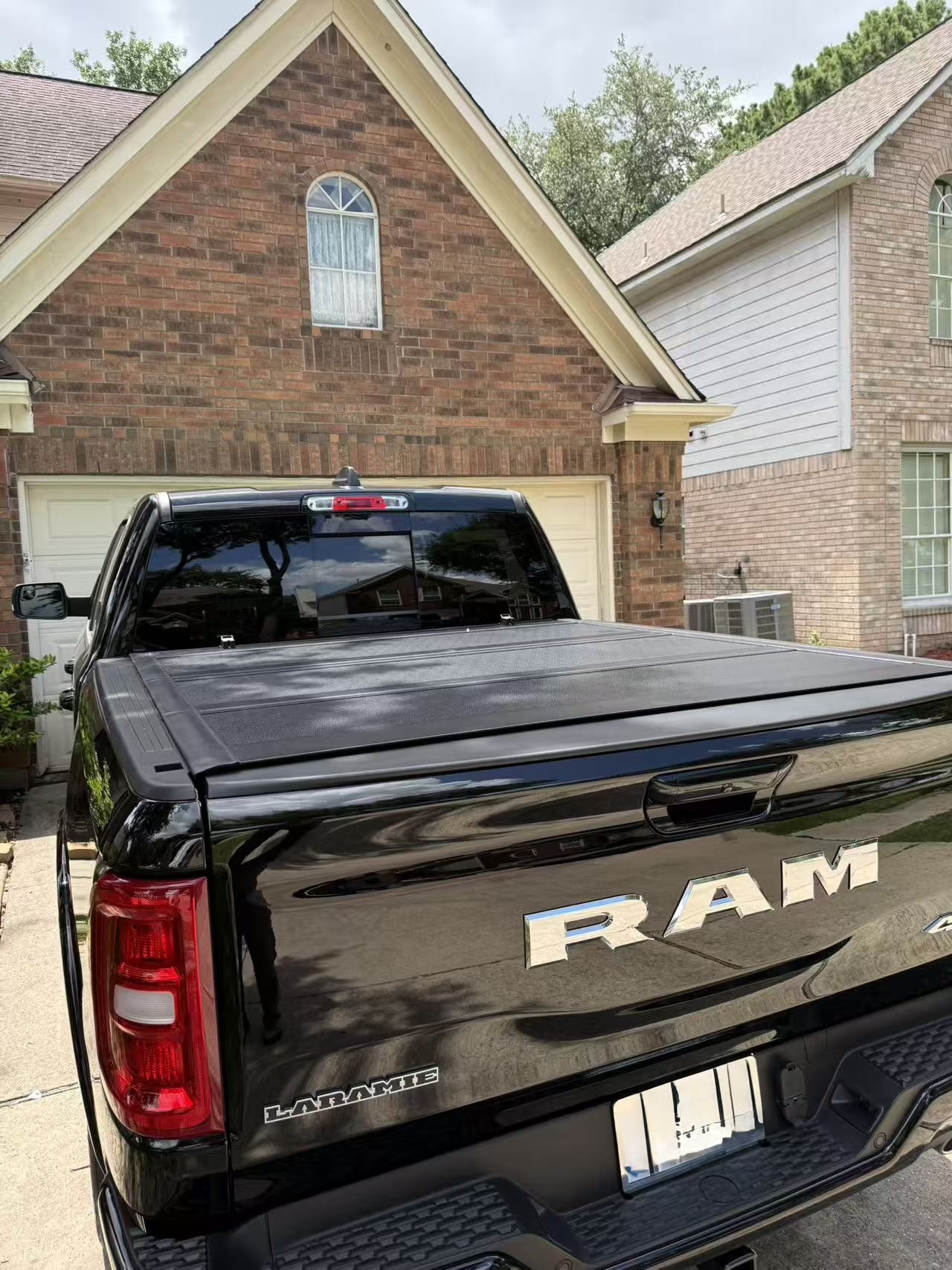
You may be able to transfer a tonneau cover to another truck if the manufacturer confirms that the exact cover and mounting system fit the replacement vehicle. Matching the advertised bed length is not enough. A hard tri-fold cover should be treated as a vehicle-specific product, not a universal lid that can be adjusted to any similar bed.
Before removing a cover from a truck you are selling, identify its part number and check the new truck’s application. That check can prevent an unnecessary removal, an unsuitable used-cover purchase, or money spent on hardware for a cover that cannot be transferred.
Table of Contents
- Why the Same Bed Length Does Not Confirm Fit
- Identify the Cover Before Measuring Everything
- What to Do With the Fitment Result
- Check the Hardware You Actually Have
- Account for the New Truck’s Accessories
- Prepare a Useful Transfer Assessment Request
- Treat Reinstallation as a Fresh Installation
- Frequently Asked Questions
Why the Same Bed Length Does Not Confirm Fit
A bed-length description tells you only one part of the application. The cover also needs to match the truck’s mounting arrangement and sealing surfaces, with sufficient clearance for the tailgate and operating hardware.
Check the year, make, model, bed configuration, and relevant factory options. Do not assume that two trucks from the same brand share a cover application, or that a redesign leaves the mounting requirements unchanged.
For a concrete example, Agri-Cover states in its LOMAX hard folding cover FAQ that its covers are model-specific and are not transferable to different truck models. That restriction should not be overridden by measuring two beds and deciding they look close enough.
Even when moving between two examples of the same truck model, verify the exact application. A similar name on the tailgate is not the same as confirmation from the cover manufacturer.
Identify the Cover Before Measuring Everything
Start with the purchase receipt, installation paperwork, and product labels. Record the brand, product line, part number, and serial number where available. A serial number can help the manufacturer identify a cover, but it is not necessarily the application part number.
Photograph labels rather than relying on memory. If the identifier is missing, take clear pictures of the closed cover, panel undersides, rails, clamps, and release hardware and ask the manufacturer for identification help.
Then compare the exact existing part with the application listed for the replacement truck. If a current catalog uses a different number, ask whether the old number was superseded or represents a different product application. Do not assume that either matching or different numbers settles every hardware question without checking the fitment notes.
A useful question to ask: “Can cover part number [number], currently fitted to [old truck details], be installed on [new truck details]? If yes, which mounting parts and vehicle-specific instructions are required?”
What to Do With the Fitment Result
The Existing Cover Is Confirmed for the New Truck
Move on to checking condition and hardware completeness. Fitment approval does not establish that worn seals, damaged clamps, or missing restraints can be reused.
The Manufacturer Specifies Different Installation Parts
Obtain the exact approved parts list and instructions before proceeding. Confirm that the manufacturer is approving your existing cover assembly with those parts, rather than describing a kit for a different cover.
The Cover Is Not Approved, or Its Identity Cannot Be Confirmed
Pause the transfer. A trial fit that appears to close does not confirm secure mounting or correct latch operation. Compare a cover designed for the new truck instead of improvising brackets or drilling to make the old one fit.
Check the Hardware You Actually Have
Before removal, photograph the installed setup and compare its components with the applicable parts list. Depending on the design, the assembly may include rails, clamps, brackets, seals, spacers, fasteners, or open-position restraints.
Inspect for missing components, damaged threads, bent parts, and deteriorated sealing material. Ask which components are reusable and which need replacement; do not assume every adhesive seal or mounting item can simply move with the panels.
For a used cover, ask the seller whether all installation parts are included. A listing described as “complete” is less useful than clear photos and an inventory matched to the manufacturer’s instructions.
Follow the removal and handling procedure for the model. Keep detached parts organized, and arrange help if the cover’s size or weight makes handling difficult.
Account for the New Truck’s Accessories
An approved vehicle application still needs to be assessed alongside the new truck’s equipment. Record any bed liner, factory tracks, toolbox, rack, rail caps, or other accessories affecting mounting space.
A cover that operated properly on the previous truck may meet a different accessory arrangement on the replacement. Confirm both attachment clearance and the movement needed to fold panels, open a toolbox, or remove the cover.
Our guide to using a tonneau cover with a toolbox or bed rack explains these overlapping spaces. If a liner is fitted, also review our guide to tonneau covers and drop-in bed liners.
Prepare a Useful Transfer Assessment Request
Gather these details before asking about transfer feasibility or installation:
- Both vehicles: Year, make, model, bed length, and relevant factory bed options.
- The cover: Brand, product line, identifiers, and purchase paperwork if available.
- Photos: Labels, panel undersides, rails, mounting hardware, and the new truck’s bed.
- Condition: Missing parts, previous repairs, leaks, or changes in how the cover latches.
- Fitment confirmation: Any manufacturer response identifying the approved application and required parts.
Ask what an installation quote includes: removal from the old truck, replacement components, preparation, reinstallation, and final operating checks may need separate clarification. Compare the complete scope with the option of a new cover rather than assuming transfer will always cost less.
For hard tri-fold cover options and professional installation in Katy, Texas, contact Prime Truck Covers. Share the vehicle and cover information to ask about available options and installation requirements. Confirm whether an existing-cover transfer can be accommodated before arranging removal or transport.
Treat Reinstallation as a Fresh Installation
Once compatibility and parts are confirmed, follow the instructions applicable to the new vehicle. Agri-Cover, for example, publishes separate vehicle-specific installation supplements alongside its main LOMAX manuals. The old truck’s clamp positions or adjustments should not become a substitute for the correct guide.
Review alignment, required latch engagement, tailgate operation, and approved open travel positions. Follow specified fastening values and inspection requirements, and resolve any securing issue before driving.
Our tonneau cover installation checklist gives you practical questions for the handover.
Frequently Asked Questions
Will a tonneau cover fit another truck with the same bed length?
Not necessarily. Check the exact cover part number against the replacement truck’s application and factory bed options. Bed length alone does not confirm mounting or operating compatibility.
Can I transfer only the panels and buy new rails?
Only if the manufacturer confirms that your panel assembly is compatible with the proposed rails and vehicle application. Buying different rails does not automatically convert an incompatible cover.
Is moving the cover the same as transferring its warranty?
No. Physical fitment and warranty eligibility are separate questions. Check the actual warranty terms and ask the manufacturer how a vehicle change or second-hand purchase affects coverage.
What if the cover has no readable part number?
Collect any receipt, serial label, and detailed photos and request identification help. Avoid buying parts or installing the cover on a different truck until its application can be confirmed.