

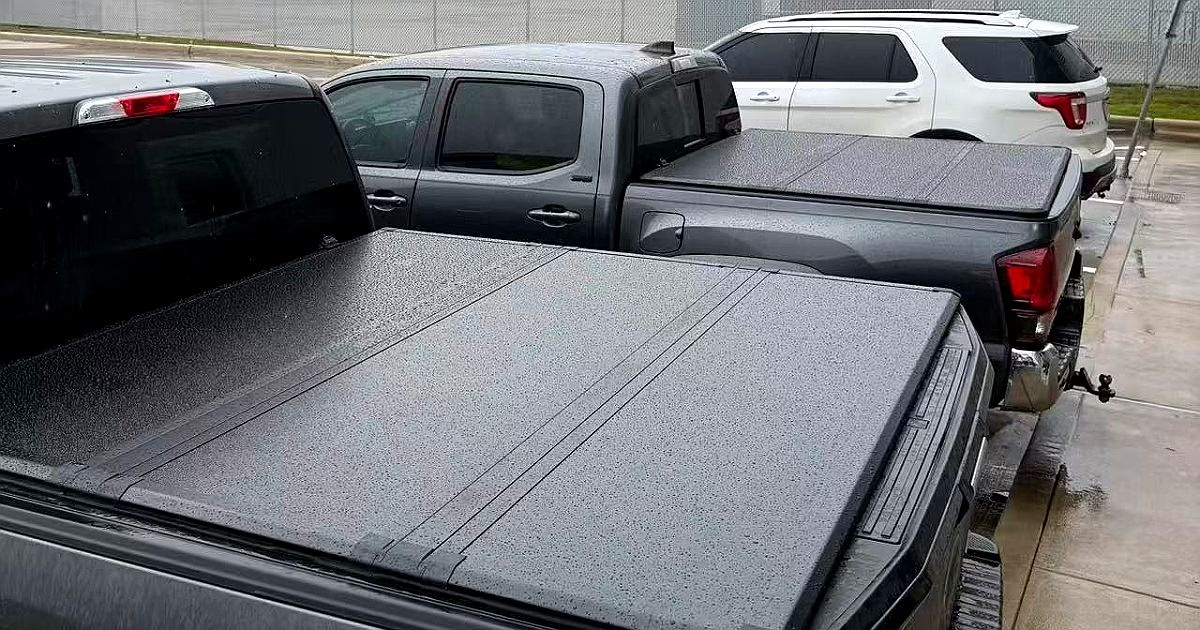
No tonneau cover makes a truck bed waterproof. A well-fitted cover keeps rain, snow, dust, and direct sun off your cargo, but the bed underneath is not a sealed container. Water can still reach it through the tailgate gap, the stake pockets, and the factory drain holes in the bed floor.
What separates a cover that performs well in bad weather from one that disappoints is rarely a single feature. It comes down to the seals, the panels, how precisely the cover is matched to your bed, and how it was installed. Here is what to look at before you buy, and what to expect once the cover is on the truck.
Table of Contents
- Weatherproof or Weather Resistant?
- What Actually Keeps Water Out
- Conditions Worth Planning For
- How Upkeep Affects Weather Resistance
- What to Check Before You Buy
- Covers and Installation in Katy and Rancho Cucamonga
- Frequently Asked Questions
Weatherproof or Weather Resistant?
Manufacturers describe covers as weather resistant, not weatherproof, and the difference matters when you decide what to leave in the bed.
A weather-resistant cover sheds rain, keeps snow and road debris off your cargo, and shades the bed from direct sun. It is not a sealed compartment. Wind-driven rain, standing water on the panels, and spray thrown up from the road can still work past seals and panel joints under some conditions.
Treat a covered bed as protected storage rather than a dry box. Anything that must stay completely dry, such as paperwork, electronics, or tools with exposed electrical components, belongs in a sealed container inside the bed.
What Actually Keeps Water Out
Seals and Sealing Surfaces
Most hard covers rely on rubber or foam seals along the bed rails, across the front wall behind the cab, at the tailgate, and between the panels themselves. These seals do most of the work.
They only perform when they make even contact with a clean surface. Leaves, grit, and dried residue along the rails hold a panel open by a fraction of an inch, which is enough to let water track inside. A seal that has been crushed, torn, or pulled loose does the same.
Panel Construction and Joints
Rigid panels hold their shape under standing water and resist pooling better than a flexible surface stretched over a frame. The joints between folding sections are a separate matter: each hinge line needs its own seal or overlap, and that is a common entry point on tri-fold designs.
Panel material also determines how a cover handles sustained heat and sunlight. Check the product description for the exact material rather than assuming every hard cover is built the same way. If you are weighing construction types, our comparison of hard tri-fold and soft roll-up covers explains the trade-offs.
Fit and Installation
A cover engineered for your exact year, make, model, and bed length seals far better than one that is approximately right. Clamp position, torque, and alignment all affect whether the seals sit evenly along the rails.
This is also where most avoidable water problems begin. A cover that sits slightly out of square, is mounted with hardware outside the specified positions, or is overtightened to close a gap will let water in regardless of how good the seals are.
Drainage
Some covers include drain tubes or channels that carry water away from the front corners. If yours has them, routing matters: a tube that is kinked, disconnected, or pointed back into the bed moves the problem rather than solving it. Covers without drainage rely entirely on their seals and panel overlap.
The Truck Itself
A cover seals to the bed, not to the ground. Factory drain holes in the bed floor, stake pocket openings, and the gap around the tailgate are part of the truck and remain once the cover is fitted. Water on the bed floor after heavy rain is not automatically a sign that the cover has failed.
Conditions Worth Planning For
Heavy rain and humidity. Prolonged rain tests seals and panel joints far more than a short downpour. Humidity also brings condensation, so a closed bed can hold moisture even when nothing leaked in. Airing the bed out after wet weather helps.
Sustained sun. Months of direct sun affect finishes and gradually stiffen seals. That matters as much to long-term weather resistance as rain does, because a hardened seal no longer conforms to the rail.
Dust and wind. Fine dust travels where water does. The same gaps that let moisture in will let dust settle on cargo.
Snow and ice. Clear snow before opening a hard cover, and never force a panel that has frozen to its seal. That is a common way seals tear.
Storms and hail. Damage from weather events is usually treated separately from a manufacturing defect. Read the warranty terms so you know which is which before you need to.
How Upkeep Affects Weather Resistance
Weather resistance is not fixed at installation. It degrades as seals collect debris and latches drift out of adjustment, and a few minutes of attention keeps it close to where it started.
Wipe the rails and seals clean, check that the latches still close with the same resistance, and inspect the hinge lines for lifting or separation. Our guide to cleaning and maintaining a hard tri-fold cover covers which products to use and which to avoid.
If water does appear in the bed, work through what to check when a tonneau cover leaks before assuming a seal has failed. Incomplete closure and debris on the rails account for a large share of reported leaks.
What to Check Before You Buy
Have these ready when you compare options:
- The cover’s exact vehicle application: year, make, model, and bed length.
- Where the cover seals, including the rails, front wall, tailgate, and panel joints.
- Whether the material and finish suit the sun exposure where you park.
- Whether drainage components are included, and how they route.
- Any bed liner, toolbox, rack, or rail system that could affect sealing surfaces.
- What the installation includes and who performs it.
- The warranty terms, including which weather-related damage is excluded.
Our guide to choosing the right tonneau cover for your truck walks through the vehicle details to gather first.
Covers and Installation in Katy and Rancho Cucamonga
Prime Truck Covers supplies and installs hard tri-fold truck bed covers at both locations, with installation included in the price. Compare the cover options, or see the Katy, Texas and Rancho Cucamonga, California pages for directions and appointment details.
Contact Prime Truck Covers with your truck’s year, make, model, and bed length to confirm fit and ask about availability. Mention where the truck sits day to day, whether that is outdoors, under cover, or at a job site, so the team can discuss the options that suit those conditions.
Frequently Asked Questions
Is any truck bed cover completely waterproof?
No. Covers are designed to be weather resistant. The bed has openings of its own, including drain holes and the tailgate gap, so keep anything that must stay dry in a sealed container.
Will a tonneau cover keep snow and ice out of the bed?
A hard cover keeps most snow off your cargo. Clear any accumulation before opening it, and never force a panel that has frozen to its seal.
Can I leave tools or electronics in a covered bed?
A cover helps, but it does not replace a weatherproof case. Humidity and condensation affect a closed bed even when no water enters it.
Does a hard cover always seal better than a soft one?
No. Fit, seal condition, and installation matter more than the category. A correctly fitted soft cover can outperform a poorly installed hard one.
Water got into my bed after a storm. What should I check first?
Confirm the cover was fully closed and latched, then clear debris from the rails and inspect the seals. Check the bed’s own drain holes before concluding that the cover is at fault.