

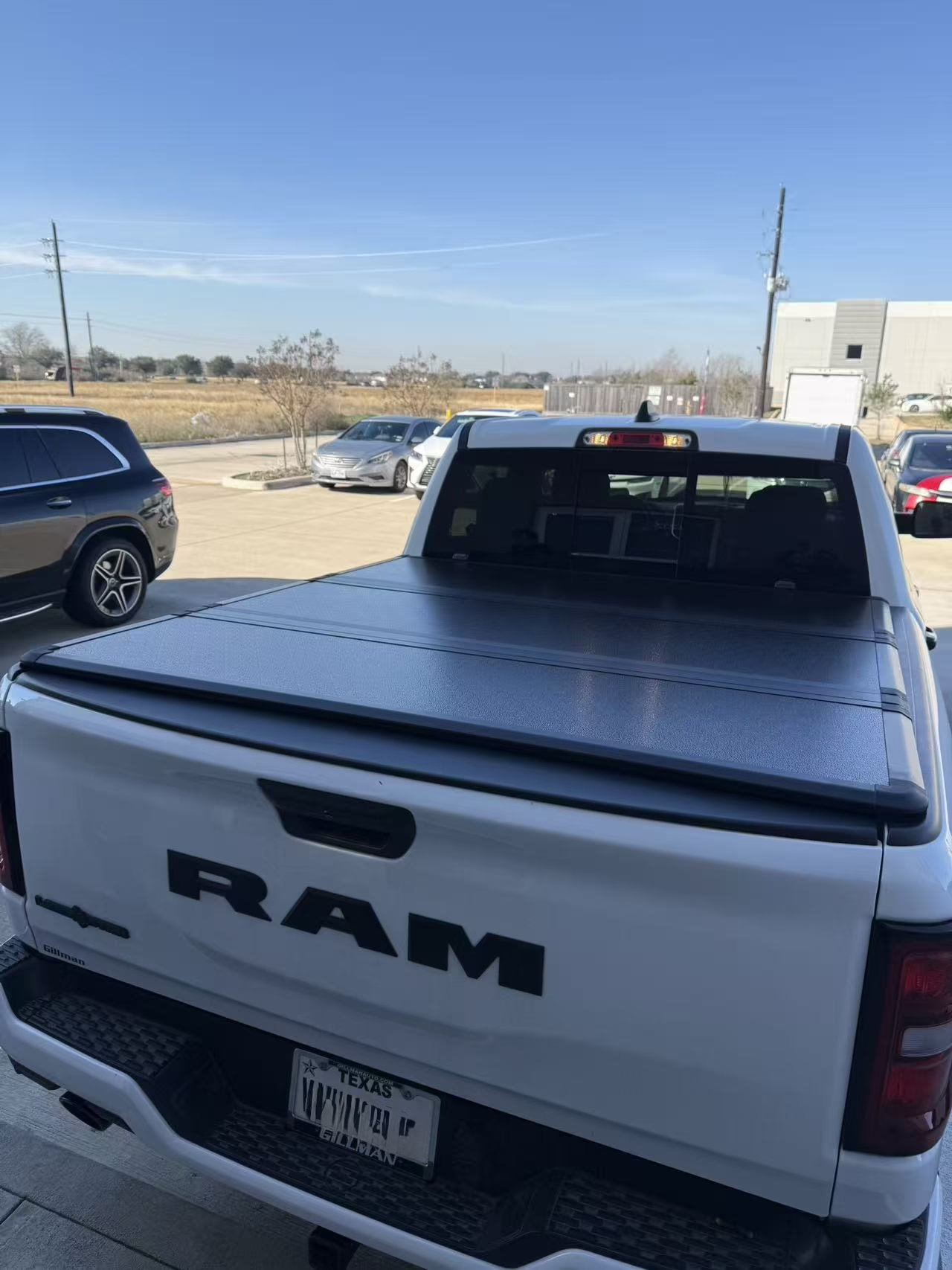
A tonneau cover suits loads that fit beneath a cover near the bed rails and routines that benefit from opening the bed from above. A truck cap adds an enclosure above the rails, making it worth considering when you regularly need covered space for taller equipment.
The choice is less about which accessory is better overall and more about what must stay covered, how you load it, and how often your cargo changes. This guide compares a hard tri-fold tonneau cover with a truck cap through those practical decisions.
Table of Contents
- What Is the Difference?
- Start With the Height of Your Usual Cargo
- Compare How You Load and Retrieve Equipment
- Plan for Occasional Oversized Loads
- Set Realistic Storage and Security Expectations
- Check Accessories, Vehicle Limits, and Parking Clearance
- Which Setup Matches Your Routine?
- Frequently Asked Questions
What Is the Difference?
A tonneau cover closes the top of the pickup bed near rail height. Hard tri-fold models use rigid folding panels, although their folded positions and removal procedures vary.
A truck cap, also called a topper or camper shell, encloses space above the bed rails with a roof and sides. Height, rear opening, windows, and side-access options depend on the model. A cap does not extend the bed floor; it changes the space enclosed above it.
Compare the actual usable dimensions rather than exterior appearance. A tall-looking cap may still have a rear opening smaller than the item you want to load. A low-profile tonneau cover can also have hardware extending below its panel surface.
Start With the Height of Your Usual Cargo
Measure the items that travel with you most days, including their cases and packaging. Separate that routine load from the largest item you carry only occasionally.
For example, consider two hypothetical setups:
- A technician carrying low tool cases: If the cases fit beneath the closed panels and remain easy to reach, a hard tri-fold cover may provide the covered space needed without a taller enclosure.
- A crew carrying tall equipment every day: If that equipment must remain upright and covered, a cap with adequate interior height and door clearance may be the more relevant option to assess.
Do not choose a cap by roof height alone. Check the narrowest point in the loading route, including the rear door opening, and any interior storage that reduces usable space.
Likewise, do not plan to force a tonneau cover closed over cargo. If the usual load is too tall, ask whether a different storage arrangement is practical or whether an above-rail enclosure better meets the requirement.
Compare How You Load and Retrieve Equipment
With a folding cover, you can uncover sections of the bed from above. That can be useful when lifting boxes over the side or arranging items before closing the panels. However, folded panels may still obstruct the front section.
A cap changes the loading route. Think through reaching equipment near the cab through the rear opening, particularly when other items are in the way. Some caps offer opening side doors or storage access; others do not.
Commercial LEER cap options, for instance, include configurations with side doors and toolboxes. Treat that as a feature to request and verify, rather than assuming every cap has convenient side access.
Before deciding, sketch where your three most-used items will sit. Then ask how you would retrieve each one at a stop without unloading the rest. Our guide to tonneau covers for work trucks explores these daily-access questions.
Plan for Occasional Oversized Loads
A furniture pickup or bulky equipment delivery can require a different opening from your everyday load. Consider both the final cargo position and the movement needed to lower or tilt the item into the bed.
A hard tri-fold cover may need removal if its folded stack blocks that movement. Some hard folding designs have an approved upright position, while others remain horizontal. Our guide to hard tri-fold tonneau cover bed access explains the distinction.
A cap’s roof and door frame can limit access from above or restrict a tall item’s loading path. If removal would be needed, ask about the specific handling procedure, assistance or equipment, storage space, and any electrical connections that must be addressed.
Do not assume either product can be removed conveniently at the collection point. If oversized loads are frequent, include the removal and reinstallation process in the comparison before buying.
Set Realistic Storage and Security Expectations
Both options can provide covered storage when correctly installed and closed, but compare the particular product’s sealing and locking arrangements. Neither product category alone guarantees a waterproof compartment or theft-proof storage.
For a hard tri-fold cover, ask how access to the releases is restricted and how that relates to the truck’s tailgate lock. For a cap, check the rear closure and any windows or side doors included in the configuration.
Keep moisture-sensitive items in appropriate protective cases. Also account for the damp equipment you load: a wet hose or muddy tool can introduce moisture beneath either enclosure.
The enclosure does not replace an appropriate cargo-restraint arrangement. Secure equipment independently rather than relying on a roof, panel, or closed tailgate to prevent movement.
Check Accessories, Vehicle Limits, and Parking Clearance
A rack or toolbox can change the comparison. Verify the complete accessory combination, including mounting space, lid movement, and access to required cargo tie-down points. Our guide to using a tonneau cover with a toolbox or bed rack explains what to check around a folding cover.
If you want to carry items above a cap, confirm that the exact roof, rack, mounts, and vehicle application are approved for that use. A roof that looks substantial does not establish a carrying capacity. LEER’s rack guidance illustrates why limits depend on the installed rack and cap combination.
Account for the installed accessory weight and cargo within the truck’s applicable limits. Ask for the weights of the actual quoted products and equipment rather than assuming one category always has the same weight advantage.
Measure the completed vehicle’s height where relevant, including racks and anything carried above them. Check your garage and regular parking locations before committing to the setup.
Which Setup Matches Your Routine?
Start by assessing a hard tri-fold cover if most cargo fits beneath the panels, you value access from above, and the approved opening or removal arrangement accommodates occasional larger loads.
Start by assessing a truck cap if taller cargo regularly needs enclosure and you can load and retrieve it through the available openings. Specify any side-access or storage options that your workday requires.
Request quotes for comparable scopes: product, installation, required mounting parts, locks, storage accessories, and any rack or electrical work. Do not make the decision using a base price that excludes the features you actually need.
For hard tri-fold tonneau cover options and professional installation in Katy, Texas, contact Prime Truck Covers. Share your truck details, usual cargo measurements, and bed accessories to ask about compatible options, availability, and an installation quote.
Frequently Asked Questions
Is a truck cap better than a tonneau cover for tools?
It depends on tool height, storage layout, and access. Low cases may fit beneath a tonneau cover, while taller equipment may need a cap’s enclosed height. Compare the openings and locking arrangements of the specific products.
Can a hard tri-fold cover accommodate tall cargo?
Possibly, using an approved open travel position or removal as instructed. Tall cargo will not remain enclosed by closed panels if it exceeds the available clearance. Secure the load separately.
Does every truck cap have side access?
No. Window and door arrangements vary, and some side-access features are optional. Ask to see the exact configuration in your quote.
Can I move either accessory to another truck later?
Do not assume so. Confirm the exact product application with the manufacturer before planning a transfer. Similar bed-length descriptions do not establish compatibility.